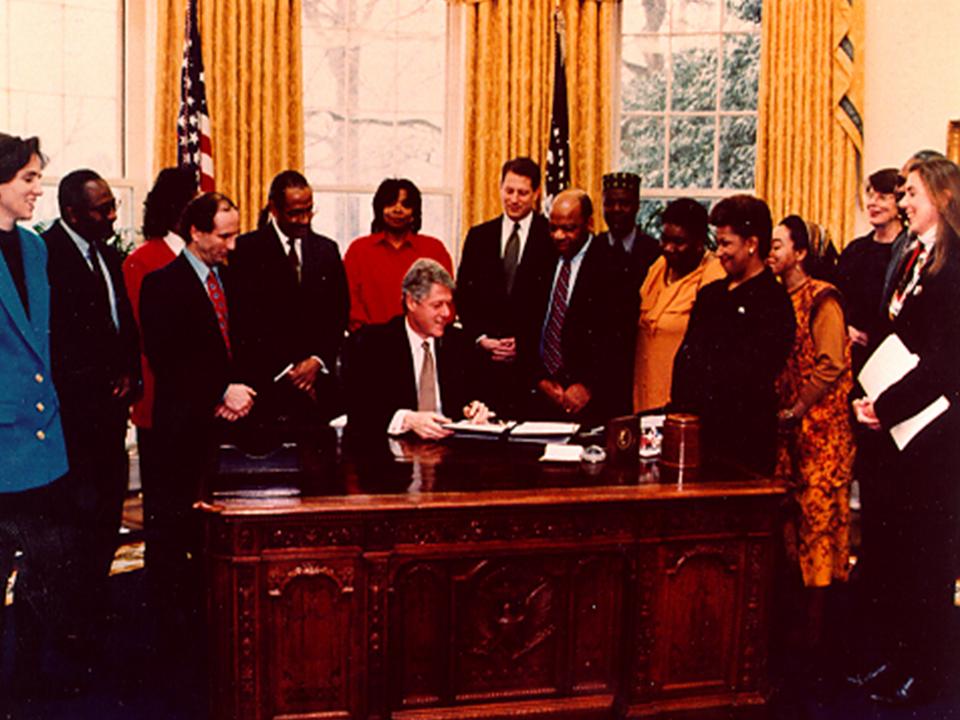
Today, February 11th, is the 20th Anniversary of Executive Order 12898: Federal Actions to Address Environmental Justice in Minority Populations and Low Income Populations.
Image from http://switchboard.nrdc.org/blogs/ahuang/president_clintons_executive_o.html
However, this was not the beginning of the EJ movement, it was just the first and largest federal recognition of the movement. Here is a brief timeline from the folks are the National Resources Defense Council documenting some milestones in the EJ movement.
"Early 1960s - Farm workers
organized by Cesar Chavez fight for workplace rights, including
protection from toxic pesticides in California farm fields.
1962 - Rachel Carson's Silent Spring details the harmful effects of pesticides on the environment.
1964
- Civil Rights Act of 1964 passed. The law's "Title VI" -- prohibiting
use of federal funds to discriminate based on race, color and national
origin -- will become an important tool in environmental justice
litigation.
1967 - African-American students take to the streets of Houston to oppose a city dump that had claimed the lives of two children.
1969
- Lawsuit filed on behalf of six migrant farm workers by California
Rural Legal Assistance plays a role in the ban on the pesticide DDT in
the United States.
1970 - U.S. Environmental Protection
Agency established to enforce laws that protect human health and
safeguard the natural environment.
1971 - President's
Council on Environmental Quality acknowledges that racial discrimination
negatively affects the quality of the environment for the urban poor.
1972 - The United States bans the use of the toxic pesticide DDT.
1973 - The EPA issues rules that phase out lead in gasoline over several years; lead levels in the air will fall by 90 percent.
1978
- Hundreds of families evacuated from Love Canal area of Niagara Falls,
New York, due to rates of cancer and birth defects; toxic chemicals
were buried decades before under neighborhood.
1979 -
African-American community in Houston opposing a landfill brings first
Title VI lawsuit challenging the siting of a waste facility."
The EJ movement is not finished yet. There is still work to be done. There are still areas like Mossville, LA, Rubbertown in Louisville, KY, Houston, TX, and Richmond, CA where minority and low income populations are subject to disproportionate levels of pollution. For example, you might have heard of the Keystone XL Pipeline. Many people are opposed to this project for climate change reasons, but for Native Canadians who live near the Tar Sands, this is an EJ issue. They are being exposed to oil spills and chemical pollution from tar sand extraction. I say this just to point out that pollution issues and EJ issues often go hand and hand. The pollution has to go into someone's back yard. Unfortunately, these communities are often left to fend for themselves, but if we all lend a hand, maybe things will start to change. Remember the wind and rivers unite us all.
Yesterday, EPA Administrator Gina McCarthy posted this video on the EPA Environmental Justice Blog.
February 2014 is Environmental Justice month! But wait a minute. What is environmental justice (ej)? Well, according to the EPA:
"Environmental Justice is the fair treatment and meaningful
involvement of all people regardless of race, color, national origin, or
income with respect to the development, implementation, and enforcement
of environmental laws, regulations, and policies. EPA has this goal for
all communities and persons across this Nation. It will be achieved
when everyone enjoys the same degree of protection from environmental
and health hazards and equal access to the decision-making process to
have a healthy environment in which to live, learn, and work."
In a previous post, I detailed two communities, Mossville, LA and Savoonga, AK. Unfortunately, communities exist all over the nation, in fact all over the world, that suffer from disproportionate exposure to toxic chemicals. These chemicals can come from factories and/or from cheaper products on local store shelves that contain more toxic chemicals.
In 1991, the First National People of Color Environmental Leadership Summit met in Washington DC. They drafted and adopted The 17 Principles of the Environmental Justice.
"1) Environmental Justice affirms the sacredness of Mother
Earth, ecological unity and the interdependence of all species, and the
right to be free from ecological destruction.
2) Environmental Justice demands that public policy be
based on mutual respect and justice for all peoples, free from any form
of discrimination or bias.
3) Environmental Justice mandates the right to ethical,
balanced and responsible uses of land and renewable resources in the
interest of a sustainable planet for humans and other living things.
4) Environmental Justice calls for universal protection
from nuclear testing, extraction, production and disposal of
toxic/hazardous wastes and poisons and nuclear testing that threaten the
fundamental right to clean air, land, water, and food.
5) Environmental Justice affirms the fundamental right to political, economic, cultural and environmental self-determination of all peoples.
6) Environmental Justice demands the cessation of the
production of all toxins, hazardous wastes, and radioactive materials,
and that all past and current producers be held strictly accountable to
the people for detoxification and the containment at the point of
production.
7) Environmental Justice demands the right to
participate as equal partners at every level of decision-making,
including needs assessment, planning, implementation, enforcement and
evaluation.
8) Environmental Justice affirms the right of all
workers to a safe and healthy work environment without being forced to
choose between an unsafe livelihood and unemployment. It also affirms
the right of those who work at home to be free from environmental
hazards.
9) Environmental Justice protects the right of victims
of environmental injustice to receive full compensation and reparations
for damages as well as quality health care.
10) Environmental Justice considers governmental acts of
environmental injustice a violation of international law, the Universal
Declaration On Human Rights, and the United Nations Convention on
Genocide.
11) Environmental Justice must recognize a special legal
and natural relationship of Native Peoples to the U.S. government
through treaties, agreements, compacts, and covenants affirming
sovereignty and self-determination.
12) Environmental Justice affirms the need for urban and
rural ecological policies to clean up and rebuild our cities and rural
areas in balance with nature, honoring the cultural integrity of all our
communities, and provided fair access for all to the full range of
resources.
13) Environmental Justice calls for the strict
enforcement of principles of informed consent, and a halt to the testing
of experimental reproductive and medical procedures and vaccinations on
people of color.
14) Environmental Justice opposes the destructive operations of multinational corporations.
15) Environmental Justice opposes military occupation, repression and exploitation of lands, peoples, and cultures, and other life forms.
16) Environmental Justice calls for the education of
present and future generations which emphasizes social and environmental
issues, based on our experience and an appreciation of our diverse
cultural perspectives.
17) Environmental Justice requires that we, as
individuals, make personal and consumer choices to consume as little of
Mother Earth’s resources and to produce as little waste as possible; and
make the conscious decision to challenge and reprioritize our
lifestyles to insure the health of the natural world for present and
future generations."
While you may be thinking that these ej issues don't affect you because you don't live in these neighborhoods, you would be wrong. You see, the wind blows and connects us all. The river runs and links us all together. The pollution doesn't stay in one place. If we fight for these communities, we fight for ourselves.
Image taken from http://www.arb.ca.gov/cc/images/hands.jpg
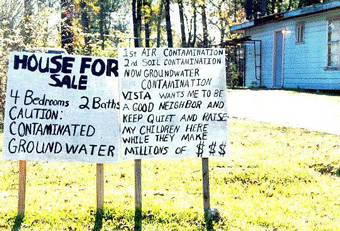
Although we are all exposed to the over 80,000 chemicals that have been created since the modern chemistry era, some are more exposed than others. Across the country and around the world, communities exist in close proximity to chemical factories, toxic waste dumps, landfills and other toxic sites. These are called fenceline communities, because often, a fence is all that separates their communities from the polluted land. Those who live in these communities are exposed to more toxic chemicals and suffer more adverse health effects than the rest of us. These communities also tend to be disproportionately minority and of lower economic classes.
One example of a fenceline community is Mossville, LA, also known as Cancer Alley. Mossville is predominantly African American community surrounded by 14 petrochemical plants.
The town has been ravaged by illness and it has been difficult for people to move since no one wants to move a town surrounded by factories.
"I got cancer. My dad had cancer. In fact, he died of cancer. It's a lot
of people in this area who died of cancer," says Herman Singleton Jr.,
51, who also lost two uncles and an aunt to cancer.
Another example is the small town of Savoonga on St. Lawrence, AK, in the Bering Strait, near Russia. The town is near an abandoned U.S. military base.
"When the military vacated Northeast Cape in the early 1970s, they left
at least thirty-four contaminated sites in a nine-square-mile area.
Contamination includes at least 220,000 gallons of spilt fuel, as well
as heavy metals, asbestos, solvents, and PCBs which are known to cause
cancer."
The town is still suffering the effects. In a village of 800, two babies were born without brains.
"As a result of these daily exposures to toxic
chemicals, those of us who live in remote places like Alaska and the
Arctic have some of the highest levels of toxic chemicals in our own
bodies. On St. Lawrence Island we have very high levels of PCBs in our
traditional foods and in our bodies, up to 10 times higher than average
U.S. levels. Yupik women within the Yukon-Kuskokwim Delta area of Alaska
have the highest levels of PBDEs -- toxic, flame-retardant chemicals
-- in their blood. These chemicals have been linked to serious
diseases such as cancer, diabetes, learning disabilities, birth
defects and reproductive harm. People in my community are being harmed
by all these diseases. Last year, we lost 19 people from cancer in a
community of about 1,200."
"“We are tired of our communities being ‘sacrifice zones’ or ‘kill zones,’ ” Ms. Roberts added.
Ms. Roberts was referring to what the environmental injustice movement
refers to as “the disproportionate” pollution burden borne by
communities of color and poorer White communities, often located near
freeways, power plants, toxic waste sites, oil refineries, rail yards,
chemical plants and other major sources of pollution."
No one should have to live like this. In the battle against toxic chemicals, we can't forget our brothers and sisters in fenceline communities around the globe.